Part One went inside the twelve-storey brewery: rice washed ten kilos at a time, seven hundred times a day; the kōji room that is left off the public tour, where the work is still done by hand; and the meeting at nine every morning that tastes every lot in the line.
→ Part One: Not at the Push of a Button
Part Two is about everything outside the brewery walls. Before I was shown around, we talked about rice.
A third of all the Yamada Nishiki

Yamada Nishiki is called the king of sake rice. It was bred in Hyōgo Prefecture in 1936 and now accounts for about thirty percent of all sake rice grown in Japan. The grains are large, with an opaque white core at the centre — the shinpaku. That core is loosely structured, so it takes up water easily and the kōji mould can work its way in. Which means the grain resists breaking when it is milled hard, and dissolves readily in the mash.
It also travels. It grows well in many places except for northern Japan and answers to whatever a brewer is aiming at. Some people compare it to Chardonnay. For any brewery chasing a highly milled daiginjō, it is the first name that comes to mind.
The reason it is grown mostly in Hyōgo and western Japan comes down to height. Table rice stands about ninety centimetres; Yamada Nishiki reaches 110, sometimes 120, and falls over. In a country with as many typhoons as Japan, that height decides the harvest. So the growing areas cluster where typhoons are least likely to land. The largest by far is Hyōgo.
The 2025 crop came to roughly thirty thousand tonnes nationwide. Dassai alone bought about 10,600 tonnes of it. A third of the most widely grown sake rice in Japan. Around 4,200 tonnes of that came from Hyōgo — some forty percent of what Dassai buys.
Being the largest buyer has made something else possible.
Every year Dassai runs a competition among its contract farmers to find the best Yamada Nishiki of that harvest. The prize money is not on any ordinary scale. From 2026, the grand-prize lot — eighty bales, about 4.8 tonnes — is bought for forty million yen. That is five hundred thousand yen for a sixty-kilo bale, more than twenty times the market price. The brewery exists because the farmers do: that is the reasoning behind it, and the aim is to lift both the quality of the rice and the farmers' own motivation. Yamada Nishiki is now grown in other regions, and the quality coming out of Tochigi Prefecture, north of Tokyo, in particular has risen. Tochigi growers place near the top every year, and have won outright.
What is interesting is that the criteria changed partway through.
At first the biggest white core scored highest. That is the conventional mark of good sake rice. It did not suit Dassai. Junmai daiginjō must be milled to 50 percent or below; Dassai works mainly at 45 and 23 percent, and goes as far as 8. (The milling ratio is the share of the grain left after milling.) Which is to say they mill very hard.
They had thought at first that a bigger core was better. But because Dassai mills so far, a large core makes the grain more likely to break. To polish cleanly all the way to the centre, the core wants to sit as close to the middle as possible and not be too large. Milling, year after year, is how they found that out.
One year's grand-prize rice was faultless as Yamada Nishiki. The core was magnificent. Milled hard, it did not work. The following year, the criteria changed. A brewery building its own scale for judging sake rice, against its own method, and rewriting it as it goes.
I asked whether the prize money comes back as quality.
Hard to measure directly, he said. But the motivation is unmistakably higher. Farmers compare notes on what to try this year — the smaller growers especially, helping each other. And the quality does seem to improve every year.
The sake made from the winning lots is DASSAI Ambition. The best rice, brewed with everything they have. 363,000 yen for 720 ml. The bottle is titanium — not for the look, but because dropping glass means the sake can be chilled rapidly after pasteurisation.
Japanese agriculture tends to run in separate vertical lanes. This draws one line from the farmer to the person drinking. It is a brewery looking past its own craft to the growing of the rice itself.
No white core, so it could be milled further

However good the farmer, five to ten percent of any Yamada Nishiki harvest comes out off-grade. Grains that do not match in size. Grains split lengthways. Grains damaged by disease. Rice that cannot be graded.
The flavour itself is not the problem. The problem is that sake made from ungraded rice cannot carry a designation — junmai, ginjō, any of them. So most breweries will not buy it, and the farmer lets it go as scrap.
Dassai saw that as a problem worth solving. The brewery stands because the farmers do, and the number of farmers keeps falling; was there anything that could be done, even a little. That was the discussion inside the company.
They had used off-grade rice for some time. It was sold as Dassai Tougai, milled to 30 percent, priced below the rest of the range — it even turned up as the star on the all-you-can-drink lists of izakaya chains.
As a statement about off-grade rice, it went nowhere. All anyone saw was the cheapest Dassai on the shelf. The work behind it stayed invisible.
So the thinking turned over.
The conversation inside the company ran like this. Top-grade Yamada Nishiki has a large white core, and because that core collapses, the grain cannot be milled past a certain point.
Then off-grade rice, with no core to speak of, ought to mill further.
A milling machine has a mesh that sifts out broken grain. Once a grain falls below about six percent of its original size, it drops through as bran. So they stop short of that, with a margin: 8 percent, almost the limit of the machine. That is DASSAI Future – with Farmers. It sells at just under 20,000 yen for 720 ml, and a good number of European visitors buy it after hearing this story.
Whether it would even make kōji was unknown until they tried. At 8 percent there is almost nothing left for the mould to get into. The saccharifying power came out a little low, but it made proper kōji. The rice it had to break down had also been milled to 8 percent, and was easy to dissolve to begin with. A weak kōji was enough.
The most highly milled sake Dassai makes is made from rice that cannot be graded.
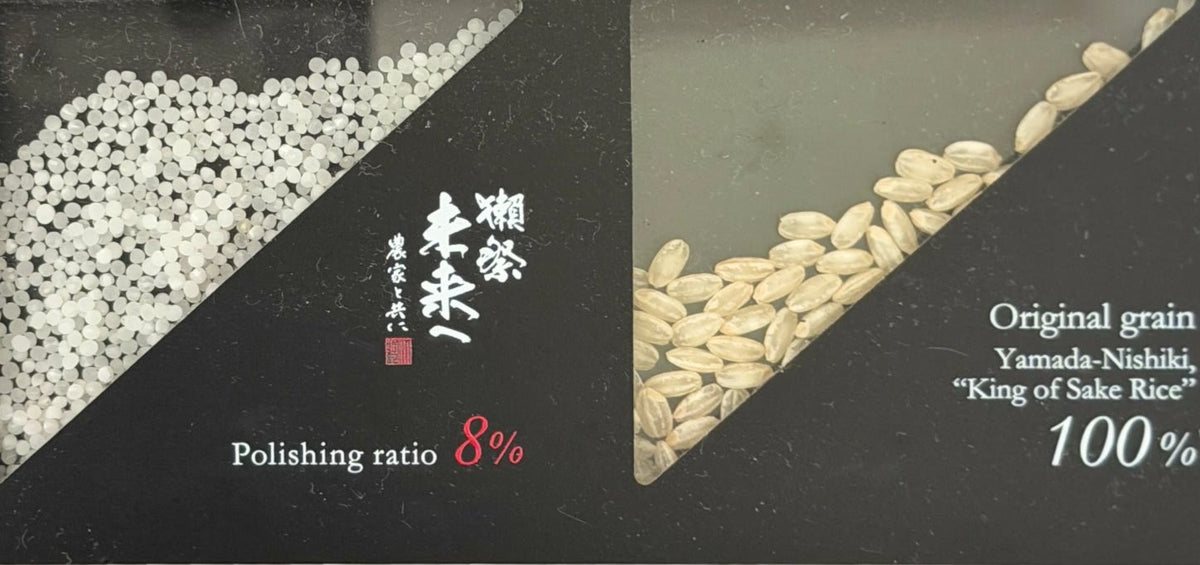
In the display case of the shop beside the brewery, two triangles sit side by side. On the left, white grains milled to 8 percent. On the right, labelled Original grain, Yamada-Nishiki, the rice they started from. The same rice.
They stopped selling it as the cheap one. From the same rice they made the most highly milled sake in the range, and priced it as exactly that.
Nothing to throw away

A low milling ratio also means bran on a different order of magnitude. Mill to 23 percent and 77 percent of the rice is not used for sake making. Long before anyone was saying SDGs, what to do with that volume was a question the brewery could not avoid.
Ask, and the answers keep coming.
It becomes rice oil. It becomes mirin. It becomes animal feed. Other companies use it as a raw material for brewer's alcohol.
The lees from pressing become kasutori shōchū — a spirit distilled from what the press leaves behind — fifteen to twenty thousand bottles a month. Lees and rice flour also feed the local Takamori wagyu cattle.
Lees and bran go into cosmetics. DASSAI BEAUTY, launched in 2020, began with a face mask carrying an extract of the lees from brewing DASSAI 23, and now runs to lotions and serums. The starting point was noticing the condition of the hands of the people who work with kōji.
Then there is soap made with the lees, narazuke — vegetables cured in them — confectionery, ice cream. Counting collaborations with other companies, the list of products born from by-products runs long.
In the Netherlands a great many people choose things on sustainability. This is not quite that story. Using up every grain bought from a farmer is not framed here as protecting anything — it simply pays for itself. But that instinct, to waste nothing, deserves to be talked about far more than it is.
DASSAI BLUE

In September 2023, Dassai opened a brewery in Hyde Park, New York — about 150 kilometres north of Manhattan, on the Hudson.
The name is DASSAI BLUE. It comes from a proverb: blue comes from the indigo plant, and is bluer than the indigo. The student surpasses the teacher. One day, the intention is, it will surpass the original.
The rice is Yamada Nishiki grown in Arkansas. At first it was shipped from Japan; now it is grown there. They took the seed over and spent the first year or two growing rice only, before brewing anything.
Rice and place do change the flavour. What differed clearly was the water. Glucose readings run higher there, and the sake comes out sweeter. The analysis sheets on the wall showed it.
To protect the taste of Dassai, anything that does not meet the standard is not sold. Which made the launch hard. Something like eight tanks were lost, and they made the opening party by the narrowest margin. As another brewery's junmai daiginjō, it would have been fine. As Dassai, it could not go out. That judgement came round again and again.
The line the brewery draws does not move for an ocean.
One of the analysis monitors I was shown was connected to the American database. Different water means fermentation behaves differently. The same thinking as the nine o'clock tasting, running across the Pacific.
DASSAI BLUE is now imported into Japan as well. Inside Japan, the fact that they are brewing sake in New York at all is still not widely known; standing in the shop, the reaction is often surprise that such a thing is happening. The current Blue has moved away from its early sweetness towards something cleaner. Some customers prefer it now; others preferred the sweeter version that first arrived.
Different water, different taste. If the wine idea of terroir is to accept that difference as the character of a place, Dassai is aiming at the opposite. To be Dassai wherever it is made. The New York brewery is also an experiment in whether that is possible.
Europe is three percent
One hard number to finish with.
Dassai's export markets, in order: China, the United States, South Korea, Taiwan, Singapore. Almost the same ranking as Japanese sake exports overall.
And Europe?
All of it together, about three percent. France leads by volume, and even France is under one percent of the total.
Domestic and overseas now run roughly half and half. Europe is three percent of that overseas half.
Europe comes last — they hear it often. Wine is too strong there.
I live in Amsterdam. In this city the Japanese restaurants can pour a serious sake pairing, and increasingly a starred French-fusion kitchen will put one good sake somewhere in the menu. Go to the second or third city and that thins out fast.
Outside the brewery, it was mountains. No station, no convenience store nearby. Almost everyone drives to work.
From this valley, a third of all the Yamada Nishiki in Japan is bought up, the heat under the farmers who grow it rises, sake is brewed in New York, and bottles go out to more than forty countries.
Eating a Dassai ice cream at the brewery shop, I tried to picture Dassai on a list in a restaurant in the Dutch provinces. Given how the cities have gone these past few years, that does not feel far off.
DASSAI Inc. — 2167-4 Osogoe, Shūtō-chō, Iwakuni, Yamaguchi
https://dassai.com
In the Netherlands, Dassai reaches many Japanese restaurants through the major importers, and can also be bought from retailers who carry sake.
This article is based on a visit to the DASSAI Inc. head brewery in Iwakuni, Yamaguchi, in August 2026, and on what I was told during the tour. The visit was arranged by Yūta Seto of the sales department, and I was guided by Masahiro Hata, team leader of the amazake and umeshu team in production. I am very grateful for the opportunity. Background facts are drawn from the official website and from primary information gathered during the visit.
One sake story a week
Brewery interviews and writing about sake, in the language of wine — straight to your inbox.
日本語版
蔵の外へ ― 農家と、世界と
山口県岩国市 / 株式会社 獺祭
前編では、12階建ての本社蔵の中を歩き、10キロずつ1日700回繰り返される洗米、一般見学では入れない麹室での手作業、毎朝9時に全ロットを飲む会議など、獺祭の品質と味わいがどのように造られているのかをまとめている。
後編は、蔵の外の話だ。蔵を見せてもらう前に、まず米の話を聞いた。
山田錦の、三分の一
山田錦は、酒米の王様と呼ばれる品種だ。1936年に兵庫県で誕生し、今では酒米全体の約3割を占める。粒が大きく、中心に心白と呼ばれる白く不透明な部分がある。心白は組織が粗いので水を吸いやすく、麹菌も入り込みやすい。つまり、磨いても割れにくく、溶けやすい。
そして、産地を選ばず、造り手の狙いに応じて幅広いスタイルに応えてくれる。ワインで言えばシャルドネのような存在だと評する人もいる。高精白の大吟醸を目指す蔵にとっては、まず思い浮かべる選択肢だ。
産地が兵庫や中国地方に偏る理由は、米の背丈にある。食用米が大体90センチなのに対し、山田錦は110から、大きいと120センチほどになるので倒れやすい。台風の多い日本では、この高さが収量を大きく左右する。だから主な産地は、台風の当たりにくい地域に集まる。最も大きい産地は兵庫県だ。
令和7年、全国で作られた山田錦はおよそ3万トン。そのうち約1万600トンを、獺祭一社が買っている。日本で最も多く造られている酒米の、三分の一だ。うち兵庫県産が約4,200トン。獺祭が買う山田錦の、およそ4割にあたる。
その最大の買い手ならではの取り組みがある。
獺祭は毎年、契約農家を対象に、その年のナンバーワンの山田錦を決めるコンテストを開いている。賞金の規模が尋常ではない。2026年からは、グランプリ米80俵を4,000万円で買い取る。一俵あたり50万円、市場価格の20倍以上にあたる額だ。「農家さんあっての酒蔵」という信念のもと、米の品質と、農家のモチベーションを上げる取り組みだという。近年、山田錦は兵庫県だけでなく東日本でも作られるようになり、特に栃木の品質が上がっている。栃木の農家は毎年上位に食い込み、グランプリも獲っている。
面白いのは、評価の基準が途中で変わったことだ。
当初は、心白の大きい米が高く評価された。良い酒米の常識である。ところが、獺祭にはそれが合わなかった。純米大吟醸の精米歩合は50%以下。獺祭では45%や23%が主力で、8%まで存在する(精米歩合=精米後に残った部分)。つまり、かなり削る。
最初は確かに心白が大きいほうが良いと思っていた。だが獺祭の場合、どうしても削るので、心白が大きいとその分だけ米が割れやすくなる。きちんと中心まで磨くには、心白ができるだけ中心にあって、大きすぎないほうがいい。磨き続けてきて、そう分かったのだという。
ある年のグランプリ米は、山田錦として文句のつけようがなかった。心白も立派だった。だが実際に高精白してみると、向かなかった。翌年から、基準が変わった。自社の製法に合わせた酒米の評価軸を、蔵が自前で作り、運用しながら書き換えている。
賞金は品質に返ってきているのか、と聞いた。
直接評価するのは難しい。ただ、品質へのモチベーションは確実に上がっている。今年はどうしよう、ああしようと、特に小規模な農家同士が情報交換をして協力している。その結果、品質も毎年良くなっていると感じるそうだ。
このコンテストの入賞米から生まれた酒が「獺祭 挑む」だ。最高の米を、最高の技術で醸す。720mlで363,000円(税込)。瓶にはチタンを使っている。意匠のためではなく、ガラスをやめたことで、火入れの後に急速に冷やせるからだという。
縦割りになりがちな日本の農業において、農家から消費者までを一本の線でつなぐ。酒の造り手としてだけでなく、米の造り手にまで視点を広げた取り組みである。
心白がないから、磨けた
山田錦は、どんなに腕のいい農家が育てても、5から10パーセントは等外米になる。粒が揃わない。縦に割れが入っている。病害を受けている。等級がつかない米だ。
味そのものが落ちるわけではない。問題は、等級のつかない米で酒を造ると、純米や吟醸といった特定名称が使えなくなることにある。だからほとんどの蔵は買わず、農家は屑米として手放すしかない。
獺祭は、この現状を課題と捉えていた。農家があって、獺祭が成り立つ。農家がどんどん少なくなっている現状を、少しでも改善できることはないか。社内でそう検討したのだという。
以前から等外米は使っていた。「獺祭 等外」という名前で、精米歩合30パーセント。通常の獺祭より安い価格で売り、居酒屋チェーンの飲み放題に入っていたことをご存知だろうか。
しかし、それでは等外米に対する取り組みとして、世間に広まらなかった。一番安い酒、というところにしか消費者の目がいかない。一生懸命やっている取り組み自体は、認知されなかったのだという。
そこで、発想が反転する。
社内でこういう話になったという。山田錦の特上米には大きな心白があり、そこが崩れるから、ある一定の精米歩合以下には磨けない――。
それなら、心白が十分に出ていない等外米なら、もっと磨けるのではないか。
精米機には、砕けた米をふるい落とす網がある。米粒が元の6パーセント以下になると、網から糠として落ちてしまう。だからマージンを取って、そこで止める。精米機の限界まで磨いた、精米歩合8パーセント。こうして生まれたのが「獺祭 未来へ 農家と共に」だ。720mlで2万円弱で販売されているが、この話を聞いて購入していくヨーロッパからの客が多いという。
麹になるかどうかは、やってみるまで分からなかった。8パーセントまで磨いた米には、麹菌が入り込む余地がほとんど残らない。結果は、糖化力こそ少し低かったものの、立派に麹になった。溶かす相手の掛米も8パーセントまで磨かれていて、もともと溶けやすい。力の弱い麹でも、十分に足りたのだという。
獺祭で一番磨かれている酒は、等級のつかない米で造られている。
蔵に併設された店の展示ケースに、二つの三角形が並んでいた。左が8パーセントまで磨かれた白い粒。右は「Original grain, Yamada-Nishiki」と書かれた元の米。同じ米である。
安い酒として売るのをやめ、同じ米で最も磨いた酒を造った。価値の定義を変えることが、農家への還元になっている。
捨てるものが、ない
精米歩合の数値が低いということは、糠の量が桁違いだということでもある。23パーセントまで磨けば、米の77パーセントが糠になる。SDGsという言葉が広まるずっと前から、この量をどう使うかは、考えざるを得ない問題だった。
聞いてみると、使いみちが次々と出てきた。
米油になり、みりんになり、飼料になる。他社が醸造アルコールの原料に使っている例もある。
酒粕は粕取焼酎になる。月に1万5,000本から2万本。酒粕と米粉は、地元の高森和牛の餌にもなっている。
酒粕と米ぬかは、化粧品にもなっている。2020年に立ち上げた「DASSAI BEAUTY」は、磨き二割三分の醸造過程で出た酒粕エキスを配合したフェイスマスクから始まり、今は化粧水や美容液まで展開している。麹を触る蔵人の手肌が美しいことに着目したのが出発点だという。
そのほか、酒粕を使った石鹸、奈良漬、菓子、アイスクリーム。他社とのコラボレーションも含めれば、副産物から生まれた商品は相当な数にのぼる。
今はやっていないが、かつては米粉のクッキーや、割れた米で作った煎餅も自社で売っていたそうだ。
オランダでは、サステナビリティを基準にものを選ぶ人が多い。だが獺祭がやっていることは、環境保護という文脈とは少し違う。捨てないことが、農家から買った米を最後まで使い切ることであり、同時に事業として成立している。ヨーロッパで獺祭を語るとき、この話はもっと知られていい。
DASSAI BLUE
2023年9月、獺祭はニューヨーク州ハイドパークに蔵を開いた。マンハッタンから北へ約150キロ、ハドソン川沿いの町だ。
名前は「DASSAI BLUE」。青は藍より出でて藍より青し、ということわざから取っていて、いずれ本家を超えるものを、という意味だそうだ。
使う米は、アーカンソー州産の山田錦。当初は日本から送っていたが、今は現地で栽培している。種を持っていき、最初の1、2年は酒を造らず、米だけを先に作ってもらったという。
米と土地の特性は味わいに違いをもたらす。はっきり違ったのは、水だった。向こうの水ではグルコース値が高く出て、酒が甘くなる。壁に貼られた分析データでも、確かに高い数値が出ていた。
獺祭の味を守るために、基準に合わないものは売らない。だから立ち上げは苦労した。タンク8本分ほど失敗し、お披露目のパーティーにぎりぎり間に合ったという。普通の蔵の純米大吟醸として出すならいい。だが獺祭としては出せない。その判断が続いたのだそうだ。
蔵の線引きは、海を越えても変わらない。
蔵で見せてもらった分析モニターの一つは、アメリカのデータベースにつながっていた。水の環境が違えば発酵の仕方も変わる。毎朝9時のテイスティングと同じ発想が、太平洋をまたいで動いている。
現在、DASSAI BLUE は日本にも輸入されている。日本国内では、ニューヨークで日本酒を造っていること自体がまだ知られていない。店頭に立っていると「そんなことしてるんですね」という反応があるという。今のブルーは、当初の甘さからすっきりした方向へ変わってきている。最初に日本に入ってきた頃より今のほうが好きだという客もいれば、前の甘いほうが好きだという客もいる。
水が違えば、味が変わる。その違いを土地の個性として引き受けるのがワインのテロワールの考え方だとすれば、獺祭が目指しているのは、その逆だ。どこで造っても獺祭であること。ニューヨークの蔵は、それが可能かどうかの実験でもある。
ヨーロッパは、3パーセント
最後に、厳しい数字を書いておく。
獺祭の輸出先は、中国、アメリカ、韓国、台湾、シンガポールの順だという。日本酒全体の輸出ランキングと、ほぼ重なる。
では、ヨーロッパは。
全部合わせても、3パーセント程度。出荷量ではフランスが一位だが、それでも全体の1パーセントに満たない。
国内と海外の比率は、今およそ半々。その海外の、わずか3パーセントがヨーロッパということになる。
ヨーロッパは最後だよね。そう言われることが多いのだという。ワインが強すぎて、と。
私はアムステルダムに住んでいる。この街の日本料理店では質の高い日本酒のペアリングができ、また、星のついたフレンチフュージョンレストランのコースに高品質の日本酒が一つ入っていることも増えてきた。だが二番目、三番目の都市に行くと、その姿は極端に少なくなる。
蔵を出ると、山だった。駅もコンビニも近くにない。社員はほぼ全員、車で通っている。
この山奥から、全国の山田錦の三分の一が買い集められ、農家の作る熱が上がり、ニューヨークで酒が造られ、40を超える国へ出ていく。
直売店で獺祭のアイスクリームを食べながら、オランダの地方のレストランに並ぶ獺祭を想像してみた。都市部でのここ数年の人気を鑑みると、郊外まで広まるのも、そう遠くない未来だと感じる。
株式会社 獺祭 山口県岩国市周東町獺越2167-4
https://dassai.com
オランダでは、大手インポーター経由で日本料理店に多く入っているほか、日本酒を扱う酒販店でも購入できます。
本記事は2026年8月、山口県岩国市の株式会社 獺祭 本社蔵を訪問し、見学中に伺った内容をもとに執筆しました。今回の訪問は営業部の瀬戸祐太さんにご対応いただき、製造部 甘酒・梅酒チーム主任の端雅広さんに案内していただきました。このような機会をいただき大変感謝しております。基本情報は公式サイトおよび訪問時の一次情報をもとにしています。
週に一度、日本酒の話を
蔵元インタビューと、日本酒についての読みもの。週1回、メールでお届けします。