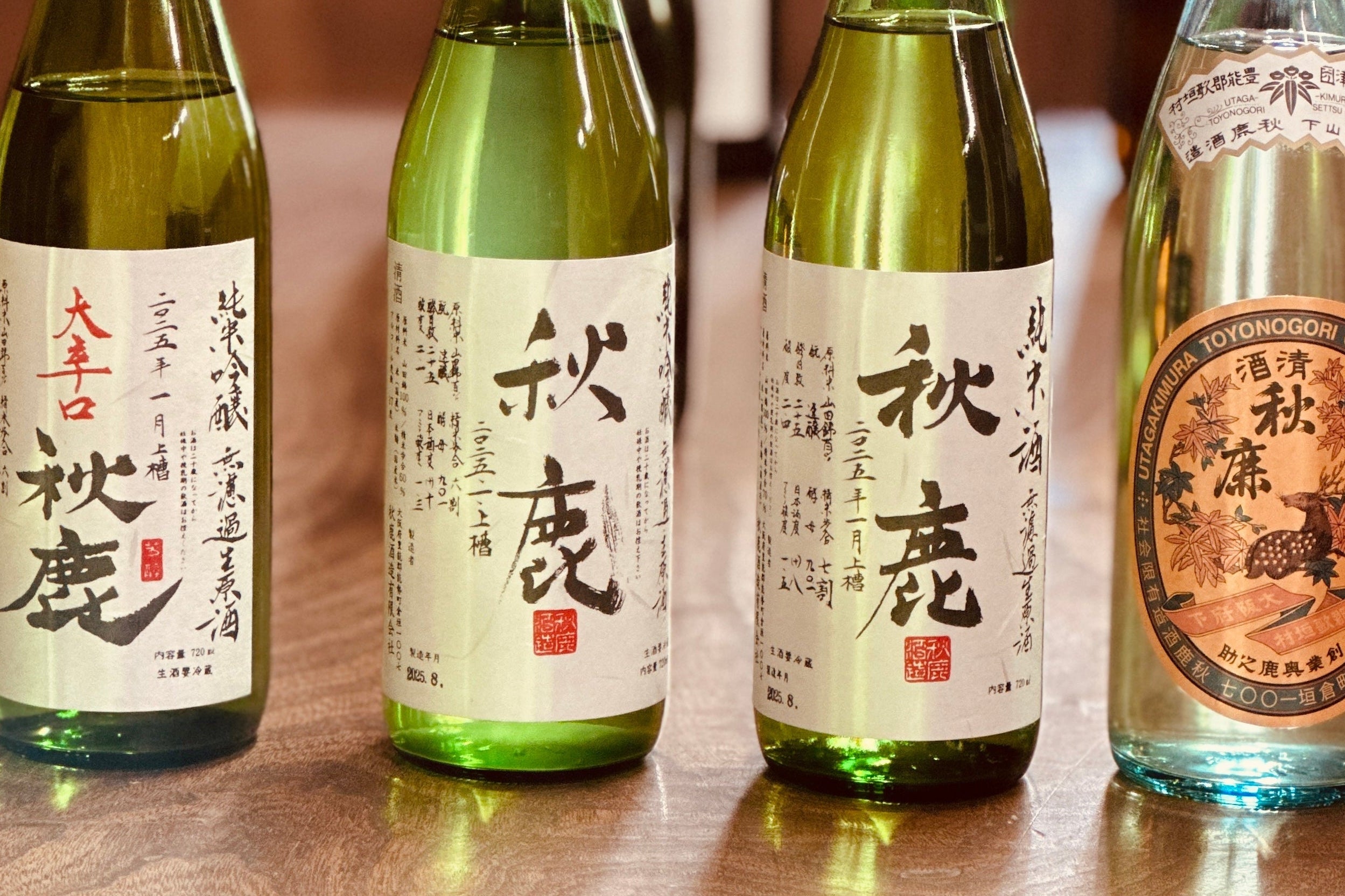
Most of a sake label is not for you.
The brewery's name, the poetry, the family crest, the prefecture — none of that tells you how the sake will taste. Nor, really, does the grade. Junmai, honjōzō, tokubetsu: these describe how a sake was made, and a brewer's production choices are not the same thing as a flavour.
I spent years reading labels the wrong way round, looking for the grade first and wondering why it kept letting me down.
What you want is narrower. You want to pick up a bottle you have never seen and know roughly what is waiting inside. Five things on a label will tell you that.
Before the five, one detour — because the characters themselves are easier to remember than they look.

The characters are pictures
Chinese characters began as pictures, and some still look like the thing they describe.
米 (kome) is rice: grains scattering from a stalk.
大 (dai) is a person standing with arms and legs stretched wide, which is how it came to mean large.
Then there is 酉 (tori), a jar for alcohol. It has stayed inside every character that has to do with fermentation ever since.
酒 (sake) is that jar with three strokes of water beside it: liquid in a jar.
醸 (jō) is the jar plus brewing — the character in ginjō and honjōzō.
酵 (kō) is the jar with fermentation: the character in yeast.
酢 (su) is vinegar.
醤 (shō) is soy sauce.
Even if we cannot read the characters, we can recognise the background of the characters with the picturing.
Find 酉 on a bottle and you are looking at a word about making alcohol. You now have three of the pictures you need.
Five things worth finding
None of these are the grade. Each of them predicts something you can taste.
吟醸 (ginjō)
Rice polished to sixty per cent or less. The yeast, working cold and hungry, throws off aromas of banana, apple and melon. Acidity and umami stay low. Add 大 (dai) in front and the effect is more pronounced still.
生酛 (kimoto) / 山廃 (yamahai)
The yeast starter was built slowly, with lactic acid bacteria left to make the acid themselves over a month. Higher acidity. Sometimes mushroom, sometimes cheese.
生 (nama)
Unpasteurised. Fresher, livelier, more forward on the nose than a pasteurised bottle of the same age. It needs the fridge.
にごり (nigori)
Rice particles left in, so the liquid is cloudy white. Creamier texture, fuller body, more of the rice itself.
古酒 (koshu)
Aged, usually two years and often much longer. Amber to brown, with nuts, dried fruit, soy sauce and a great deal of umami.
Two of these five are where my own taste has moved over the years. I chased ginjō aroma when I was younger, and I am grateful for it — it was the gateway. Now I reach for kimoto and koshu more often, for the structure underneath.
What the grade does and does not tell you
The grade is not useless. It answers two narrow questions.
Was alcohol added?
If 純米 (junmai) appears, no. If it does not, a small amount was. This affects less than people expect — tasted blind, the two are often hard to separate.
How far was the rice polished?
吟醸 (ginjō) means sixty per cent or less remained. 大吟醸 (daiginjō), fifty. 本醸造 (honjōzō), seventy. This one matters, and it is why ginjō is on the list above.
特別 (tokubetsu) means special selection, and can be earned three different ways. Treat it as a brewery telling you they are proud of the bottle, not as a style.
Then there is everything the label will never carry. The kōji — whether the mould was grown sparsely or thickly, and therefore how savoury the sake is. The fermentation temperature. The yeast strain, usually. Whether it was pressed under pressure or hung in bags.
A sake polished to eighty per cent, with careful kōji work and proper ageing, can be more sophisticated than a daiginjō polished to thirty-five. The grade will never tell you that. Only the glass will.
Five characters get you a long way, and then they stop. What is printed narrows the field. Tasting closes it.
📍 In your glass
You have a junmai and a junmai ginjō from the last two weeks. Buy a third bottle carrying one of the other four: 生 (nama), にごり (nigori), 生酛 (kimoto), or 古酒 (koshu). Any of them. The shop will have at least one.
Then set all three out and taste them in the order you bought them, without food this time.
The point is not to like the third one best. It is to notice that you predicted something before you opened it, and to see how close you were.
That is the whole skill. Everything after this is repetition — and repetition is how it stops being work.
The next step
Everything here is easier to hold onto once you have tasted it side by side. That is really all a course is for.
WSET Sake Course
Level 1 Award in Sake is a single day in Amsterdam: six hours, a guided tasting through the main styles, and an internationally recognised certificate at the end.
Level 2 goes considerably further into how each of these decisions shapes what ends up in the glass.
More in this series

Reading a Sake Label
Most of a label is not for you. Five words predict how a bottle will taste — and one character, a jar drawn three thousand years ago, unlocks the rest.

How Sake Is Made
Rice has no sugar and no acid. Both are made by living things — and four decisions a brewer makes along the way separate one bottle from the next.

What Is Sake?
Four ingredients, and no sugar in any of them. Where sake comes from, what a brewer can do with it, and how to stop guessing at the shelf.