Say 1982 Bordeaux to someone who cares about wine and watch their face change. Or 1996 Champagne. Or a Riesling with twenty years on it that has just started to turn towards petrol and honey.
In wine, age is value. The cellars, the vintage charts, the drinking windows, the auction rooms — the whole apparatus rests on the idea that time improves certain bottles, and that knowing which ones is a skill.
Ask a sake brewery what happens if you keep their sake for five years and you will get one of two answers, depending on which brewery you ask.
Most will tell you it will not be at its best. A few will tell you that is roughly when it starts to get interesting.
Both are describing something real.

Two evaluations, not two words
Sake that has been kept too long develops a smell the industry calls hine-ka. Its main component is dimethyl trisulfide, and the brewing literature describes it as pickled radish — takuwan, the yellow daikon pickle.
Here is a line from a peer-reviewed Japanese brewing journal that changes how you read the whole subject.
Hine-ka is treated as an off-flavour in the ordinary storage and distribution of sake, and is evaluated as a characteristic aroma in long-aged sake.
Not two compounds. Two verdicts.
But that is only half of it, and the more interesting half came later, when researchers took sake from the national market survey that tasters had flagged for hine-ka and compared it against sake with no hine-ka, and against deliberately long-aged sake.
The compounds of age rise in all three groups. What differs is the balance between them.
In the flagged sake, the sulfur compounds are high relative to everything else. Very little else has developed. It smells of one thing.
In the long-aged sake, a whole family has built up alongside the sulfur — products of the Maillard reaction, the same slow browning that colours bread crust and caramel, running here over years instead of minutes. Sotolon, furfural, diethyl succinate, a range of carbonyls. The sulfur is still there. It is simply no longer the loudest thing in the glass.
The researchers put the difference plainly: in the flagged sake, sotolon was mostly below the level at which anyone can detect it.
So the question is not whether a sake has the compounds of age. It is whether it has all of them, or only the fast ones.
Sulfur arrives early. Maillard takes years. Pull a bottle out at the wrong moment and you meet the first without the second — which is what most sake sitting too long on a shelf is doing.
Sotolon, which you have already met
Sotolon deserves a paragraph of its own, because you know it.
It is the compound behind vin jaune. It is in flor-aged Sherry, in aged Sauternes, in Madeira and Tokaji. That dense, faintly savoury, honey-and-walnut-and-fenugreek note that makes a glass of Château-Chalon unmistakable is largely sotolon.
In sake it forms through the Maillard reaction, and by a second route from the breakdown of an amino acid. On the flavour wheel it sits against honey, dried fruit, molasses and soy sauce.
The numbers are worth having. Most people detect sotolon at around 2.3 micrograms per litre. Sake contains anywhere from none at all up to 140. In one twenty-six-year-old bottle it measured sixty-one times the detection threshold.
A wine drinker meeting a good koshu for the first time is not encountering a foreign smell. They are meeting a compound they already have a shelf of references for, arriving from a completely different direction.
What the brewery actually controls
There is no legal definition of aged sake, which leaves the brewery more room here than almost anywhere else in sake production.
Temperature is the largest lever, and the range is enormous. A sake held at zero and the same sake at fifty degrees are changing at something like thirty times different speeds — a month in the warm doing roughly what three years in the cold would do.
The trials bear it out. Six months at 35°C and the sulfur compounds rise more than tenfold. Six months at 0°C and almost nothing moves.
Three real versions of that decision:
Minus five degrees, just above the point sake freezes. Enzyme activity effectively stops. Niizawa in Miyagi holds every bottle it makes at minus five from production through to shipping.
Three to four degrees, using snow. Hakkaisan in Niigata packs around a thousand tonnes of snow into a storage house and keeps 360,000 litres at about four degrees year round on nothing else. Their own explanation for the trouble is not about temperature: a refrigerated tank passes the faint hum of its own machinery into the liquid, and a snow room has no machinery. Whether that is audible in the glass I cannot tell you.
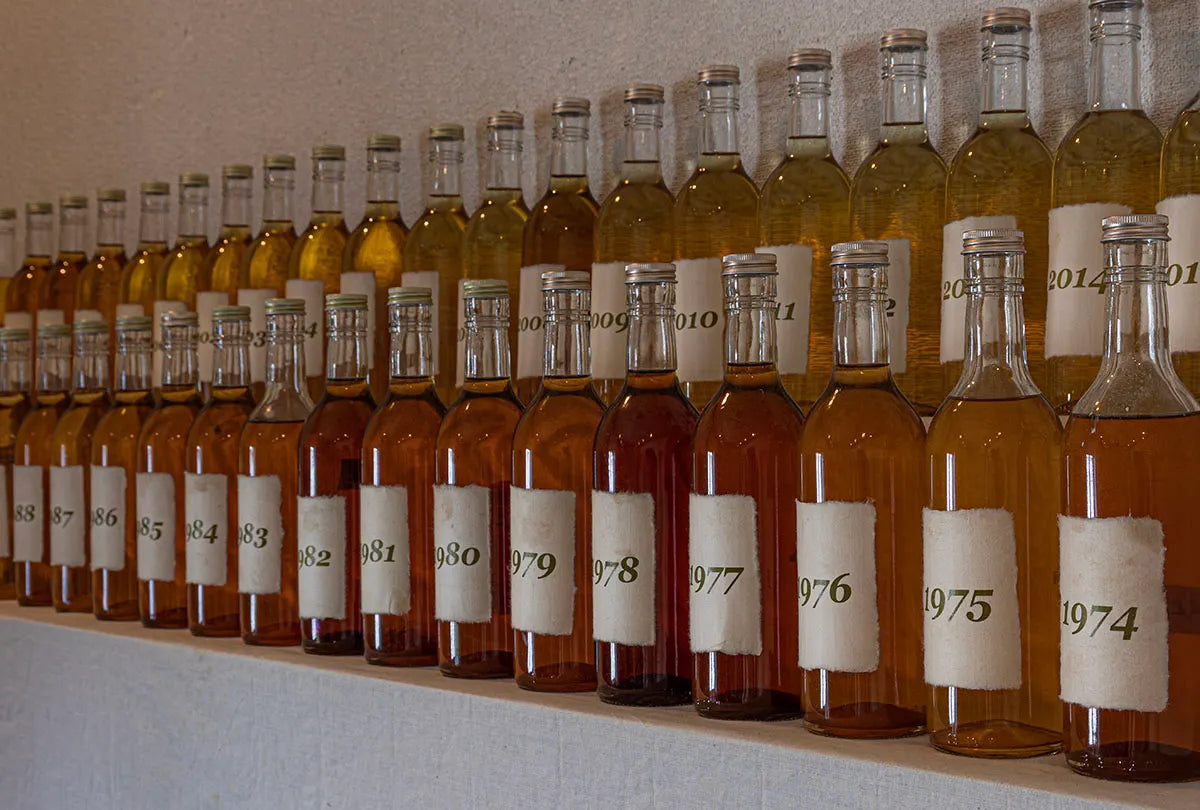
Ambient. No control at all. This is the route to amber, to soy sauce and dried fig — and also the route to failure. Some breweries choose it anyway, knowing from years of experience how their own sake behaves, and taste every tank once a year to check.
Temperature is the loudest variable but not the only one. Also in play: the size of the vessel and how much air sits above the sake, tank against bottle, how much oxygen gets in at all, whether the sake was pasteurised, light, and how far the rice was polished. Less-polished rice carries more protein, so more amino acids, so more Maillard development — and more sulfur. It is the accumulation of these choices that decides what ends up in the glass.
A hundred years of new sake
None of this is new. Aged sake was ordinary in Japan until the late nineteenth century, and then it stopped, for reasons that had nothing to do with taste.
From 1878 the government of the day levied duty at the moment sake was pressed rather than sold. Press a tank and you owed tax on it immediately, whether it sold or not — whether it survived or not. If the sake spoiled in storage, or leaked from the cedar vat, the bill stayed the same. Breweries sold as fast as they physically could, and within a generation the idea of holding anything back had gone.
The tax itself was replaced during the Second World War, and the modern system — duty at shipment — was settled into law by 1953. Hold a tank now and you owe nothing until it leaves the building. But the culture did not come back. Post-war Japan was a quantity-before-quality country: rice was short, breweries were stretching what they had, and the industry was measured on volume. Nobody was going to tie up a tank for a decade.
The national apparatus pointed the same way. Japan's central sake competition, which has run for over a century, is called the National New Sake Appraisal — it judges sake from the season just finished. For a hundred years the thing the country formally rewarded was freshness.
By around 1965, as the economy recovered, a handful of breweries began trying long ageing again. Government production quotas made it difficult to do seriously. But the idea that sake must be drunk within a year of pressing — which had held for roughly a hundred years — finally began to loosen.
A few breweries persisted anyway, and they are worth naming.
Shiraki Tsunesuke in Gifu, founded 1835, started in 1971. The sixth-generation owner's account of how it began is unglamorous: a bottle had been forgotten in a corner of the brewery, and when they opened it, it was golden and mellow and good. The brewery still records that the tax office advised them, repeatedly, to sell it quickly. They refused. Their oldest stock is fifty-three years old.
Kidoizumi in Chiba redesigned the brewing method with ageing in mind. Their flagship, Kokin, is all Yamada Nishiki, over twenty years old, and blended by the brewery from several tanks.
In 1985, twenty-eight breweries formed an association for long-aged sake. Their survey found more than two hundred aged products already on the market — most of which, by their own account, existed because the sake had not sold.
The oldest sake the national brewing institute has examined was found in a private house in Niigata and dated to 1756. Two hundred and forty-six years old when they reached it.
The international judges split the category
In 2023 the International Wine Challenge, which has run a sake division since 2007, established separate categories for aged sake.
Amber Style: coloured, yellow through to amber, at least three years from pressing, storage method unspecified.
Aged Style: stored specifically to prevent oxidative development, at least one year in the brewery, and still close to clear.
From 2024 the Aged Style gets its own trophy — meaning the competition now hands an award to sake that has been aged and has visibly not changed.
Then look at who keeps winning in the clear-coloured Aged Style.
2024: the category trophy went to NIIZAWA KIZASHI 2019, Niizawa Brewery.
2025: the category trophy again, for Zankyo 2018 — and the Miyagi regional trophy for NIIZAWA 2018. Both Niizawa.
2026: the category trophy went to Keiryu Daikoshu, from Endo Shuzojo in Nagano. Niizawa took the Miyagi trophy, for Zankyo 2019.
Three consecutive years on the podium, twice at the top of it. This is the brewery keeping everything at minus five degrees.
At the Amber end the names change more. The 2026 regional winner was Hana mo You, a long-aged junmai from Hanasui Brewery in Hiroshima, brewed in 1988 — thirty-eight years in bottle.
A judge's note on Tatsuizumi's Junmai Ginjo Tatsu Label No.3, from Fukushima, which won with four years: very pale straw, nutmeg, star anise, stone minerality, raisin, cinnamon, brown sugar; mellow on the palate, acidity still bringing freshness.
Four years, and the colour of a young wine.

📍 In your glass
📍 In your glass
Two bottles, and the point is the gap between them.
Hakkaisan Yukimuro Junmai Daiginjo, eight years — eight years at around three degrees, in the snow house.
Akishika Yamahai 2017 — ambient storage, no control and beautifully aged, a yamahai to begin with.
Pour them side by side and look before you smell. Then smell before you taste.
Both have had years. Only one of them shows it.

The next step
Everything here is easier to hold onto once you have tasted it side by side. That is really all a course is for.
WSET Sake Course
Level 1 Award in Sake is a single day in Amsterdam: six hours, a guided tasting through the main styles, and an internationally recognised certificate at the end.
Level 2 goes considerably further into how each of these decisions shapes what ends up in the glass.
More in this series

Sake and Food: Where Wine Struggles
Pairing, from the other direction. Asparagus, eggs, seafood, mushrooms are hard to put a wine next to — and the reasons have almost nothing to do with sake.

Temperature and Glassware
A wine list sorts by colour before anything else. Sake has every colour on that list, and one more — and each one is telling you something about what was done after fermentation.

Sake Styles, the Wine Way
A wine list sorts by colour before anything else. Sake has every colour on that list, and one more — and each one is telling you something about what was done after fermentation.

Reading a sake label
Most of a label is not for you. Five words predict how a bottle will taste — and one character, a jar drawn three thousand years ago, unlocks the rest.