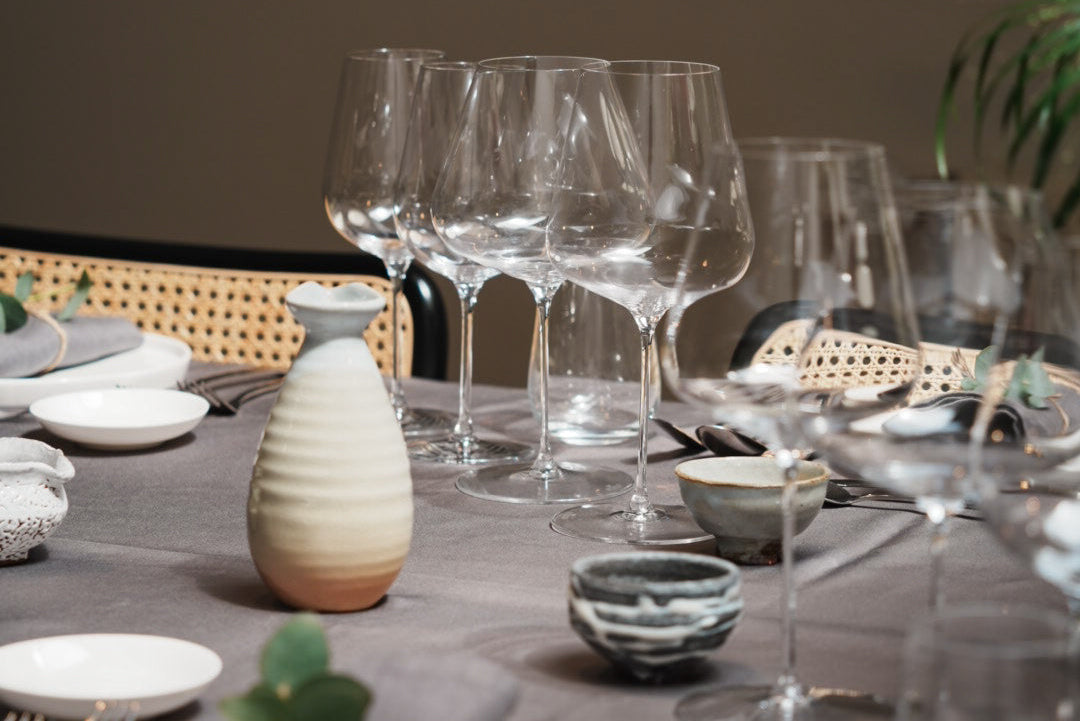
Japanese has ten words for the temperature of the same bottle.
Snow-cold at five degrees. Blossom-cold at ten. Cool at fifteen. Room temperature. Then, warming in five-degree steps: sunlit, skin-warm, lukewarm, upper, hot, and a final one that means something like flying past.
People were enjoying the differences between these long before anyone could explain what was causing them.
Everything on these pages so far has belonged to the brewer. The polishing, the kōji, the yeast, the moment to stop, the years in tank. You have been reading someone else's decisions off a label.
These last two are yours. Temperature, and what you pour it into.

The same sake, three temperatures
A Japanese research team held one sake at three temperatures — thirty-six, forty-five and fifty-five degrees — and measured what came off the surface at each.
At thirty-six, the apple and fruit aromas were strongest.
At fifty-five, the top of the range, those had given way to a grain and cellar character, and a floral edge that had not been there before.
Nothing was added and nothing removed. The heat simply decided which aromas were allowed to leave the liquid.
This is the part I find hardest to convey to wine drinkers, because wine offers no equivalent. Above eighteen degrees a wine falls apart — the alcohol takes over and the fruit collapses. Sake climbs straight past that and arrives somewhere else.
There is a second fact about temperature that matters just as much, and it has nothing to do with the sake.
Your own palate is not equally sensitive at every temperature. Taste thresholds have been measured across a range from seventeen to forty-two degrees, and they fall lowest — meaning you detect the most — somewhere between twenty-two and thirty-two. Warm the liquid into that band and you are not only changing what the sake gives off. You are moving your own tongue into the part of its range where it notices most.
Which is worth sitting with, because it means the coldest glass is rarely the most informative one. It is the most refreshing. That is a different thing.
Sources: aroma measurements by Shimadzu Corporation with Osaka University; taste threshold data from McBurney et al. (1973) and Moskowitz et al. (1973).
The edges, and the table
Too cold is below about five degrees. The aromas stop leaving the liquid, your palate is far below the band where it notices most, and a sake with real umami in it stops reading as umami and starts reading as bitterness and grip.
Too hot is above fifty-five. The complexity goes and the alcohol stays. You are drinking warmth.
Between those, the choice is genuinely open — and the most useful way to make it is to look at what is on the plate rather than what is in the bottle.
Matching the temperature of the dish is the key. This sounds obvious and is ignored constantly. Nowhere more so than with soup. Hotpot, broth, noodles — anything where hot liquid is the point. Warm the sake into the same register and the two carry on in the same conversation. Soup is built on umami, which is what warming the sake was for, and it is salted, which cancels out the awkwardness umami usually creates in a drink. This is why the Japanese winter table is what it is, and it was worked out several centuries before anyone measured anything.
Try warm sake wherever there is umami, including in food that has nothing to do with Japan — aged cheese, mushrooms, a tomato sauce. Food umami has a habit of making a drink taste drier and more bitter than it is, and a delicate cold sake has nothing to defend itself with. Warming brings the sake's own savoury weight up to meet it.
And cold has its own territory. Where the dish is delicate and fresh — sashimi, oysters, a salad with acidity in it — chill the sake and let it stay out of the way. That restraint is its own kind of pleasure, and an unexpected one if you have spent the evening warming things.
Sources: taste interaction principles from WSET Level 2 Award in Sake; the rest is how I actually decide.
Where the alcohol goes
In 2015 a team led by Kohji Mitsubayashi at Tokyo Medical and Dental University built a camera that photographs alcohol vapour, and pointed it down into wine glasses of different shapes.
At thirteen degrees, in a wine glass, they found a ring. The alcohol concentrated around the rim, and the centre of the glass was comparatively clear of it.
In a straight glass and a cocktail glass, no ring. The same wine at twenty-four degrees, no ring either.
So the wine glass is doing something quite specific, and only under specific conditions. When you put your nose into a tulip-shaped glass of something cold, you are putting it into a low-alcohol hole in the middle. The ethanol has gone to the edges, out of the way, and what reaches you is what you wanted. Mitsubayashi described the shape as a very sophisticated functional design, and on this evidence it is.
Pour the same liquid into a straight-sided tumbler and the alcohol arrives first. With a sake at seventeen per cent, that is not a small difference.
The study stopped at twenty-four degrees, so nobody has photographed what happens at forty-five. But the ring had already gone by twenty-four, and I would not expect a glass to be managing the ethanol for you at kanzake temperatures. Which is worth knowing before deciding that a wine glass is the answer to everything.
Source: Arakawa et al., Analyst, 2015.
Choosing a vessel
So the question is not which vessel is correct. It is what you want to happen.
A wine glass, if you want the aromas and want the alcohol out of the way. Small, tulip-shaped, narrowing at the top. Right for anything you would enjoy the way you enjoy a white wine — lighter, higher in acidity, driven by fruit, and served cold. You already own several.
A larger bowl, if the sake is full and complex and you want room for it to open. The same logic you apply to a Burgundy.
An o-choko, if you want the opposite. The small cup gives very little aroma, and that is the point — what it gives instead is the palate. Body, texture, weight, without the nose arriving first. It is also the sensible choice for warm sake, since no glass is going to manage the ethanol at that temperature anyway.
The o-choko is usually explained as a hospitality object, and it is one. But it is also a control. Small pours mean the sake changes less in the cup, and mean you catch it changing on purpose rather than losing it to time. Pace, temperature and attention, all governed by how much you put in.
I also think the rim matters more than people give it credit for — how thick it is, how it meets your lip, how much arrives at once. I have no study to point you to on that one. Only years of noticing it.
📍 In your glass
📍 In your glass
Take one bottle — a junmai, or the kimoto if you bought one — and pour four glasses from it.
Two cold, straight from the fridge: one in a wine glass, one in the smallest cup in the house.
Then warm the rest to about forty-five degrees and pour the same two again.
Four glasses, one bottle. Smell each before you taste it, and pay attention to how much alcohol arrives first.
Notice, too, that the warm pair are landing on a tongue that is working nearer the top of its range. You are not imagining the extra detail.
If you want to see the whole argument at once, make a miso soup and drink the warm one alongside it.

The next step
Everything here is easier to hold onto once you have tasted it side by side. That is really all a course is for.
WSET Sake Course
Level 1 Award in Sake is a single day in Amsterdam: six hours, a guided tasting through the main styles, and an internationally recognised certificate at the end.
Level 2 goes considerably further into how each of these decisions shapes what ends up in the glass.
More in this series

Sake styles, the wine way
A wine list sorts by colour before anything else. Sake has every colour on that list, and one more — and each one is telling you something about what was done after fermentation.

Reading a sake label
Most of a label is not for you. Five words predict how a bottle will taste — and one character, a jar drawn three thousand years ago, unlocks the rest.

How sake is made
Rice has no sugar and no acid. Both are made by living things — and four decisions a brewer makes along the way separate one bottle from the next.

What is sake?
Four ingredients, and no sugar in any of them. Where sake comes from, what a brewer can do with it, and how to stop guessing at the shelf.