Open any wine list and the first thing it does is sort by colour. Red, white, rosé, sparkling. Nobody taught you that arrangement.
You absorbed it, and now you use it before you have read a single producer's name.
A sake shelf offers you nothing of the kind, which is why it feels like a wall rather than a room.
So start where you already start. Sake has every colour on that wine list, and one more besides.
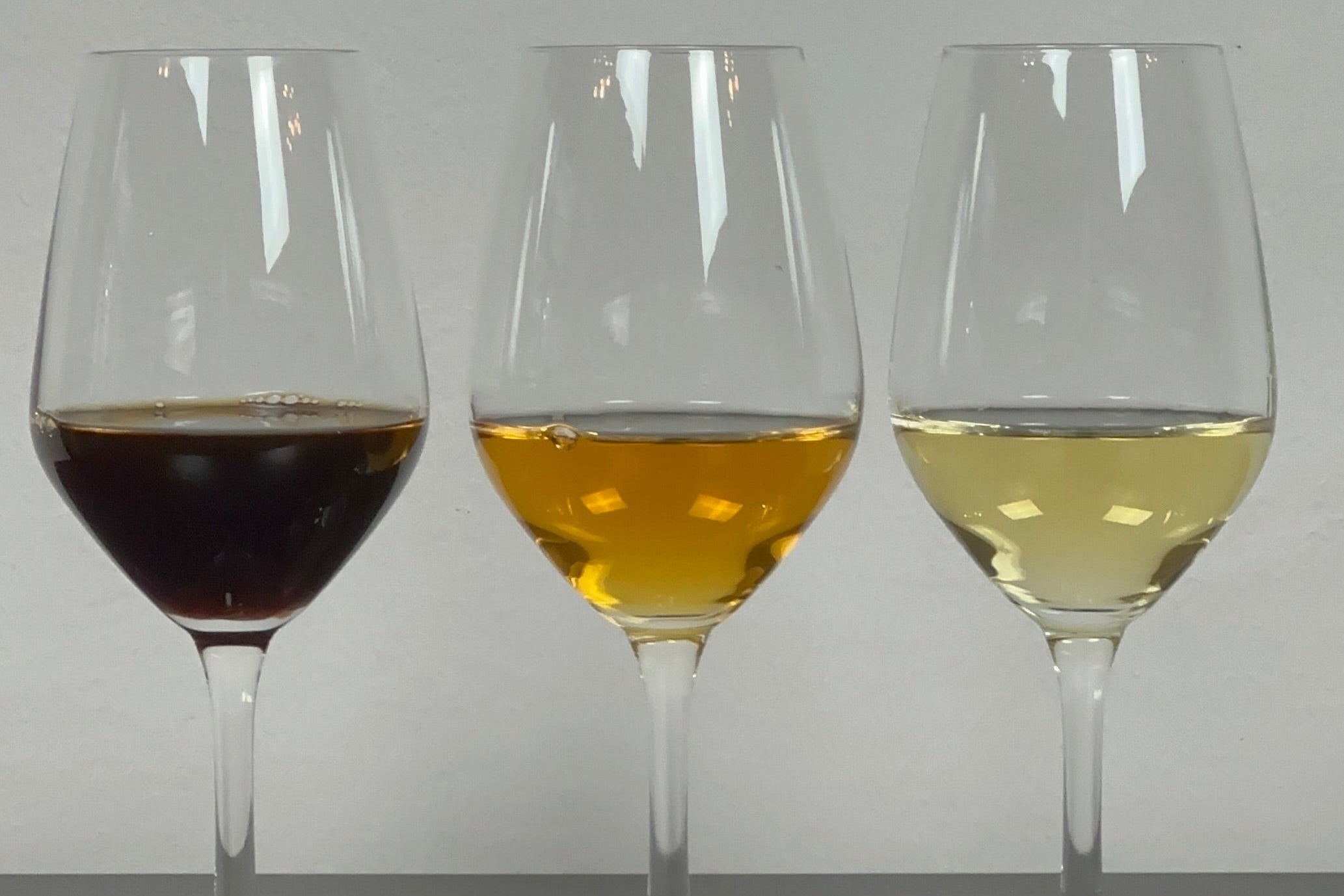
Sake has every colour on the list
Clear and colourless
The great majority. And this is the surprise: it is not what sake looks like when it leaves the press. Freshly filtered sake is a pale lemon-green. The colour is taken out afterwards, with activated charcoal.
Pale gold
Sake that skipped the charcoal. It is called muroka. A growing number of brewers now choose it, having decided that what the charcoal removes alongside the colour — flavour, texture — matters more than the colour itself.
Cloudy white
Nigori. Rice particles left in, so the liquid is milky. Not unfiltered — Japanese law requires filtration — the filter simply has larger holes. Light lees give a creamy texture; heavy lees something thick and rich. Turn the bottle over several times before pouring.
Pink
Rosé sake, made three ways: ancient red rice, red kōji, or a red-pigmented yeast developed by the Brewing Society of Japan. The yeast is the difficult one. It ferments weakly, and the colour lives inside the yeast cells themselves, so clarifying the sake takes the colour out with it.
Amber to brown
Koshu. No legal minimum, but most has been kept at least two years. Caramel, toffee, molasses and nuts, and often mushroom, soy sauce and pickled radish alongside them.
Sparkling
Bubbles, either injected under pressure or produced in the bottle. The category was invented in the late 1990s and is still loosely defined.


What the colour is actually telling you
What the colour is actually telling you
In wine, colour is mostly about the fruit and what was done with the skins. That is decided in the first days, and it is close to irreversible.
In sake, colour is almost entirely about what happened after fermentation. Charcoal or no charcoal. Coarse filter or fine. Two years in tank or two months.
The colours sort your shelf fast, but they are piles of process, not piles of taste.
And they only get you so far, because almost every bottle in the shop lands in the first pile.
Colour, and what it costs
Colour, and what it costs
Colour in sake is a chemical reaction, and how far it runs is a decision.
Sake darkens through Maillard reactions between sugars and amino acids — the same browning that happens to bread in an oven, only over years rather than minutes. As it runs, colour arrives and freshness fades. Both are governed by the same two things: time, and the temperature it spent that time at.
So the brewer chooses a direction. To hold the fruit, the sake goes into a small sealed vessel kept cold, sometimes below freezing, and very little happens at all. To go the other way, it is left warmer in a larger tank with more air, and the reaction is allowed to run.
The same sake, the same two years, and two entirely different bottles at the end of it.
Which gives you a rough rule for a shelf.
Colourless means the fruit was protected — and that the charcoal has been through it. Expect clean, expect precision, and do not expect much weight.
Gold means the charcoal was skipped, or some time has passed, or the sake was kept somewhere warm. More texture, more layers, and more of whatever the brewer decided to leave in.
Amber means the reaction was allowed to run a long way. Very little fruit left, a great deal of umami.
That is as far as colour will take you. For the clear majority it takes you nowhere at all, and then you are back to two questions. Does the aroma lead with fruit and flowers, or with cereal and something lactic? Is it light, or is it rich? The first is fermentation temperature. The second is how much of the grain was polished away.


📍 In your glass
📍 In your glass
Buy a bottle with a colour in it. Muroka, nigori, or a koshu — whichever the shop has.
Pour it beside one of the three you already own, and look at them together before you smell anything.
Then taste the coloured one and ask where the fruit went.
I still do this in the shop, before I read a single word on the label.
The next step
Everything here is easier to hold onto once you have tasted it side by side. That is really all a course is for.
WSET Sake Course
Level 1 Award in Sake is a single day in Amsterdam: six hours, a guided tasting through the main styles, and an internationally recognised certificate at the end.
Level 2 goes considerably further into how each of these decisions shapes what ends up in the glass.
More in this series

Reading a Sake Label
Most of a label is not for you. Five words predict how a bottle will taste — and one character, a jar drawn three thousand years ago, unlocks the rest.

How Sake Is Made
Rice has no sugar and no acid. Both are made by living things — and four decisions a brewer makes along the way separate one bottle from the next.

What Is Sake?
Four ingredients, and no sugar in any of them. Where sake comes from, what a brewer can do with it, and how to stop guessing at the shelf.