Osogoe, Iwakuni City, Yamaguchi Prefecture.
Up in the mountains, with no station and no convenience store anywhere near, stands a twelve-storey building. As a sake brewery, it looks like nothing I have seen before.
What is made here is probably one of the best-known sakes in the world. And probably the most misunderstood one.
There is no tōji — no master brewer. The brewery runs all year round, rather than only through the winter as sake breweries traditionally do. Seven to ten thousand kilos of rice are processed in a day. Data is taken from every tank, every day. The equipment is the newest available. All of this is true. But the conclusion most people draw from it — that the sake must therefore be made by machines in a factory — is not.
In August 2026, I visited the brewery: Dassai.
Hygiene is absolute. You pass through an air shower and a shoe-sterilising station at the entrance, put on a cap, wash and sanitise your hands, and only then go any further in.
1948, in the Mountains Above Iwakuni

Dassai is made by DASSAI Inc. Until 1 June 2025 the company was called Asahi Shuzo Co., Ltd.
Brewing on this site goes back to 1770, in the Edo period, but the present company was founded in 1948, in the years just after the Second World War, by Kiichi Sakurai and his second son Hiroji — the father of Hiroshi Sakurai, the current chairman. They were granted a brewing licence soon after, and began selling under the name Asahi Fuji.
The turning point came in 1984. After the sudden death of his father, Hiroshi Sakurai took over the family business at thirty-four. Sales had fallen to a third of what they had been ten years earlier, and the brewery ranked fourth even within Iwakuni. Rather than keep fighting for the local market, he stopped making futsū-shu — ordinary table sake — brewed nothing but junmai daiginjō, and took it to Tokyo. The tōji on the staff at the time had never made junmai daiginjō, and nobody inside the brewery believed it would work. The sake went on sale in 1990, under the name Dassai.
The rest we know. It worked. That one brand now accounts for more than ninety percent of sales.
The tōji left nine years later.
The name comes from Osogoe, where the brewery stands, and from Dassai Shooku Shujin, a pen name used by the poet Shiki Masaoka; the two share a character. This history is drawn in two manga by Kenshi Hirokane, the manga artist behind the Shima Kōsaku series. It is worth picking up, and there is an English edition: The Challenge of DASSAI — From the mountains to the world. Seeing how many times a hard setback was turned into an opening changes the way you look at the bottle.
The fourth generation, Kazuhiro Sakurai, has been president since 2016. Since then the brewery has moved its weight overseas: brewing on site in Hyde Park, New York, running since September 2023, and the company renamed after its own brand. The stated target is annual sales of one hundred billion yen. For the year to September 2025, sales were 21.37 billion yen, a record.
Only junmai daiginjō is made here. Only Yamada Nishiki is used. Not a single bottle of futsū-shu. Nothing in this brewery is milled to anything above 50 percent — that is, less than half of each grain remains.*
And there is no tōji.
* Every product is milled to 50 percent or below, but some cannot carry the junmai daiginjō designation. The reason comes later. The brewery also makes kasutori shōchū, distilled from the lees left after pressing.
Ten kilos, seven hundred times a day
The rice is milled in a separate building and brought in at the tenth floor. From there it moves down one floor at a time as the process advances. The design does not fight gravity.
It is washed and soaked ten kilos at a time. That works out at seven hundred to a thousand batches a day. It used to be done in fifteen-kilo lots. The unit was made smaller on purpose, to control it more finely.
The opposite of efficiency.
Limited soaking is timed to the second, and the target water content changes from day to day — 34 percent on one, 36 or 37 on another. If the year's rice is hard to dissolve, they take the water higher so the steamed grain comes out softer. Rice from a different region gets a different target. This is neither guesswork nor a fixed machine setting. An infrared moisture meter sits beside the soaking tanks, and the soaked rice is measured. Each lot is looked at, a target is set, the work is done, and the result is measured. For every batch, the origin and condition of the rice, the water temperature and the soaking time in seconds are all recorded. It is this fine adjustment, they say, that holds the quality steady.
Then the rice is steamed. As it came out of the machine, two brewers held a large white cloth open between them and caught it. It is carried on in the cloth while it is still hot. Where it is going is the kōji room.
The one room not on the tour
Dassai runs public tours twice a day, but one room is left off the route: the kōji room, where steamed rice is inoculated with a mould that converts its starch into fermentable sugar. I was allowed in.
The room was 36.7°C. The walls and the tables are stainless steel. Steamed rice was being brought in batch after batch, and the brewers were breaking every grain apart with their fingers. Twenty-four tables, ten to twelve people working. Each table has a scale built into it, and the weight of water to be driven off is set before anyone's hands start moving. By the end the room goes past 40°C.
A machine for making kōji was brought in from the United States at one point. In the end too much of what the quality demanded was beyond it, and the work is still done by hand.
Steamed rice comes out differently from one day to the next. That day the surface was dry; other days it comes out slack and wet. For that difference, they say, hands are the best instrument.
The kōji made here is not used straight away. It is dried, frozen, and analysed batch by batch, because the enzyme strength the mould produces — its activity — changes with the rice. Rice that is hard to dissolve gets a strong kōji; rice that is not gets a weaker one. It is kept so that the two can be matched.
Which is to say: a range of kōji with different characters, held ready, and chosen against the rice of that year.
Nine every morning, the whole lot

In the middle of the fermentation hall there is an analysis room, benches and instruments in rows. The wall is covered in graphs, one for every single tank. Alcohol, acidity, how the sugar is being used up, the temperature of the mash. The progress of every fermentation, laid out.
Every tank is measured twice a day, morning and evening. Around three thousand batches a year, all of it recorded. On top of that, the same recipe is brewed by different teams in different lots — set up that way on purpose, to push the quality higher.
And at nine every morning, the production manager, the head of the brewery and the team leaders taste every lot in the line. The bottles on the bench are open to all staff. If something is better or worse, is the cause the rice or the process? To get to that, the record of each batch and the taste of that morning are put side by side.
Because only one kind of sake is made here — junmai daiginjō, from Yamada Nishiki — the difference in raw material comes down to the milling ratio and little else. With the variables held still, comparison is easy. Soaking times, heat treatment, timing: the process is compared in the same detail, and methods are changed. The narrowness of the range, the willingness to try and fail, and the conditions for testing are what they credit for the quality. Three thousand batches a year is also three thousand experiments.
None of which was planned. In 1999 a failed craft-beer venture cost the brewery its tōji. The staff had to brew on their own, and they had to brew all year. Every time the conditions changed, they went after quality again, and this is the shape that came out of it. It also happens, they say, to be an unusually good way to make sake better.
Because the line is already drawn

Dassai's policy is that you should drink the taste of Dassai as it leaves the brewery, kept properly along the way. So what they will not do is clearly drawn.
No nama. Pasteurisation deactivates the enzymes completely, because any enzyme left alive will move the flavour inside the bottle. No ageing either. They believe the sake is at its best fresh out of the brewery, and nothing is built on the assumption that time improves it. No more than three days between pressing and pasteurisation. Before shipping, it is held for about three months at around minus ten degrees, just short of the point where it would freeze.
And they will not sell to anyone who does not handle it refrigerated. In Japan or abroad. Everything going overseas goes in a refrigerated container.
However much it would sell, it does not go to anyone who might let the taste move after it leaves. That is the philosophy of this brewery.
Which also means that inside that line, everything is open.
Pressing is one example. The brewery uses an ordinary Yabuta press, and it also has a centrifuge. Without applying pressure, it throws the heavy lees outward and lifts the clear sake from the inside. With no pressure on it, the taste comes out cleaner. The sake pressed this way is DASSAI 23 Centrifuge.
There are two ways of pasteurising, too. Besides five minutes at 63°C, the Hayata method feeds carbon dioxide into the sake as fine bubbles and applies pressure, finishing the pasteurisation at a lower temperature and in less time than usual. The result tastes somewhere between a pasteurised sake and an unpasteurised nama. It cannot be made in volume and it is expensive. They keep doing it to get a difference in taste.
Machines are not there to make the work easier; they are there to raise the quality. The centrifuge and the Hayata method, they say, are both equipment for that.
The yeast is not disclosed. The brewery was once known for Association No. 1801; now it uses a blend of its own strains. They would rather you came to the glass without a preconception about the yeast. If it tastes good when you drink it, that is enough.
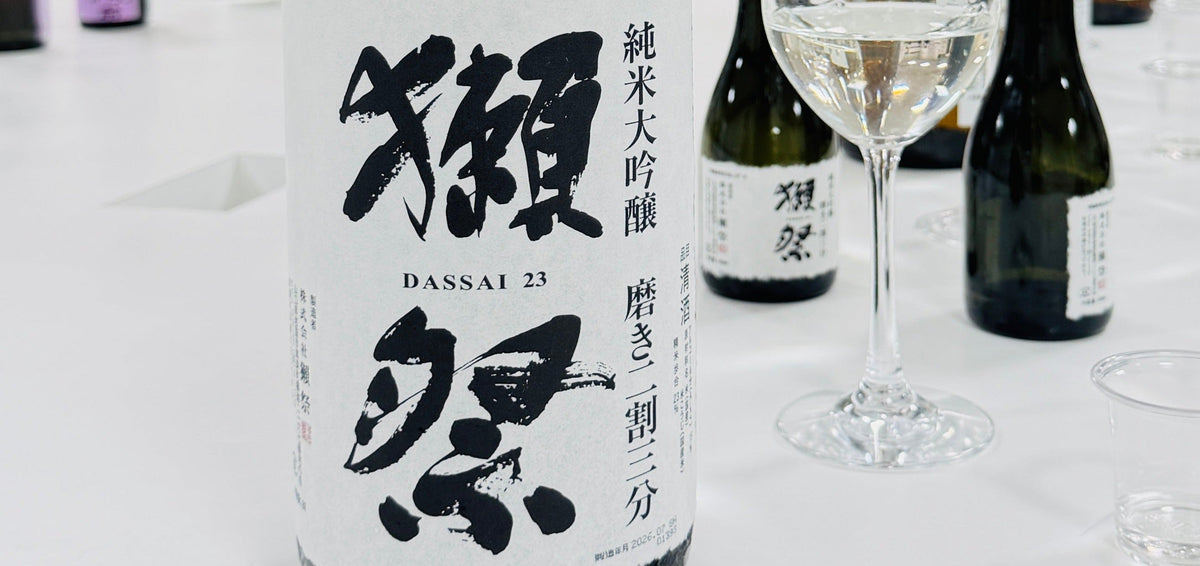
At the top of the range, the current challenge is DASSAI Beyond. The best Yamada Nishiki available at any given moment, milled as far as it will go. Enjoy DASSAI 23 first and then move across, they say, and the difference comes into focus.
But because the milling ratio changes with every production, no figure can be printed on the label. Under the current rules, a sake that cannot state its milling ratio cannot be called junmai daiginjō.
A brewery that makes nothing but junmai daiginjō sells a sake that cannot be called junmai daiginjō.
The designation, or the sake they want to make. Dassai chose the sake. Deciding first what has to be protected is what makes a decision like that possible.
In Closing
In Japan, Dassai is usually talked about as the brewery with no tōji, the brewery that brews on data. Both are true.
But what I saw and heard inside was rice washed ten kilos at a time, seven hundred times over; people in the kōji room whose fingers never stopped; and a meeting at nine every morning that drinks the entire line to find out why. This cannot be done at the push of a button.
And the consistency of this brewery runs well beyond its walls. Dassai buys a third of all the Yamada Nishiki grown in Japan, has built its own grading system for the farmers who grow it, and brews sake in New York. Those are the subject of Part Two.
One sake story a week
Brewery interviews and writing about sake, in the language of wine — straight to your inbox.
日本語版
ボタンひとつでは、できない
山口県岩国市 / 株式会社 獺祭
山口県岩国市周東町獺越(おそごえ)。
駅もコンビニも近くにない山の中に、地上12階建ての建物が立っている。酒蔵としては、今まで見たことのない姿だ。
ここで造られているのは、世界で最も名前を知られた日本酒のひとつだろう。そしておそらく、最も誤解されている日本酒でもある。
杜氏がいない。年間を通して造り続ける四季醸造。1日に処理する米は7,000キロから10,000キロ。全タンクのデータを毎日取る。最新の機器を備えている。これらはすべて事実だ。だが、そこから多くの人が導く結論――「だから、工場で機械が造っている」――は、事実ではない。
2026年8月、私はその蔵を訪ねた。
衛生管理は徹底している。入口でエアシャワーと靴の除菌をするセクションを通り、帽子をかぶり、手を洗って除菌してから、ようやく中へ進む。
1948年、岩国の山奥で
獺祭を造るのは、株式会社 獺祭。2025年6月1日まで、旭酒造株式会社という社名だった。
酒造りの創業は江戸時代の1770年にさかのぼるが、現在の法人としての設立は1948年1月。戦後まもない時期に、桜井貴一と、その次男で現会長・桜井博志の父にあたる桜井博治が興した。翌月に酒造免許を取得し、「旭富士」という銘柄で売り出している。
転機は1984年。先代の急逝を受け、34歳の桜井博志が家業を継いだ。当時、売上は10年で3分の1に落ち込み、岩国市内でも4番手の零細蔵だった。博志は、地元市場での勝負から一転、普通酒をやめ、純米大吟醸だけを造り、東京で勝負する方向へ舵を切る。当時いた杜氏にも純米大吟醸を造った経験はなく、社内の誰もその成功を信じていなかったという。そうして1990年に投入されたのが「獺祭」だ。結果は我々が知る通り、大成功。現在は売上の9割以上を、この一銘柄が占める。
杜氏が蔵を去るのは、その9年後のことだ。
銘柄名は、蔵のある地名「獺越」から一字を取り、正岡子規が用いた号「獺祭書屋主人」に重ねたものだ。この歴史は、『島耕作』の弘兼憲史さんによる『「獺祭」の挑戦 山奥から世界へ』と『漫画 懲りない親父、世界へ挑む 獺祭 進化する伝統』に描かれているので、ぜひ手に取ってみてほしい。決して楽ではない試練を幾度もチャンスに変えて現在の獺祭へ成長した事実に心が動き、獺祭のボトルを見る目が変わるに違いない。
現在は4代目・桜井一宏が代表取締役社長を務める。2016年の就任以来、ニューヨーク州ハイドパークでの現地醸造(2023年9月稼働)、そして社名のブランド統一と、海外へ軸足を移してきた。掲げている目標は、年間売上高1,000億円。2025年9月期の売上は213億7,000万円で、過去最高を更新している。
造るのは、純米大吟醸だけ。使う米は、山田錦だけ。普通酒は一本も造っていない。精米歩合50%以下の酒しか、この蔵には存在しない(※)。
そして、杜氏がいない。
(※)正確には、すべての銘柄が精米歩合50%以下だが、特定名称として「純米大吟醸」を名乗れない商品も存在する。理由は後述する。また、酒粕を蒸留した粕取焼酎も製造している。
10キロずつ、1日700回
自社精米された米は別棟から運ばれ、まず10階に入る。そこから工程が進むごとに、一階ずつ下へ降りていく。重力に逆らわない設計だという。
その米を、10キロずつ洗って吸水させる。1日あたり700回から1,000回という計算になる。もともとは15キロ単位だった。より細かくコントロールするために、あえて単位を小さくしたのだという。
効率化の、逆である。
限定吸水は秒単位の作業で、目標の含水率は34%の日もあれば、36%、37%の日もある。その年の米が溶けにくければ水分を多めにして、蒸し上がりを柔らかくする。米の産地が違えば、目標数値も変わる。勘で合わせているわけでも、機械的に設定しているわけでもない。浸漬のすぐ横に赤外線水分計があり、浸けた米の水分量を実測していた。ロット毎に米の状態を見て、目標を決め、作業し、測る。仕込みごとに、どこ産のどういう米を使ったか、水温は何度か、吸水時間は何秒かが、すべて記録されている。ここでの微調整が、安定した品質につながるのだという。
その後は蒸米だ。蒸し上がった米が機械から出てくるところを、蔵人が二人がかりで大きな白い布を広げて受け止めていた。熱いうちに、布ごと運ぶ。運ばれた先が、麹室だ。
唯一、見学ルートから外れている部屋
獺祭では毎日、午前と午後に二組ずつ一般客が蔵を見学している。そのルートから唯一外されているのが麹室だ。特別に中に入れていただいた。
室温は36.7度。壁も台もステンレス。引き込みの最中で、蒸し米が次々と運び込まれてくる。蔵人がこれをすべて指でほぐしていく。台は24台、作業メンバーは10名から12名ほど。台にはそれぞれ重量計がついていて、何キロ水分を飛ばすかを設定してから手を動かす。やがて部屋の温度は40度を超える。
アメリカで麹を造る機械を導入したこともあったが、品質を追い求めていく上で、機械では対応しきれない部分が多いと判断し、現在も人の手でやっているそうだ。
蒸し上がりの米の状態は日によって違う。この日は表面がドライだったが、べちゃっとなることもある。その差に対応するには、人の手が最適だという。
ここでできた麹は、すぐには使われない。乾燥させて冷凍し、一つずつ分析する。米によって、麹菌が出す酵素の力――力価――が変わるからだ。溶けにくい米には力価の強い麹を、そうでない米には弱い麹を。うまく組み合わせられるように保管しているのだという。
手元に性格の違う麹を何種類も持ち、その年の米に合わせて選ぶということだ。
毎朝9時、全部飲む
仕込み蔵の中央に、机と分析機器が並ぶ分析室がある。壁には、タンク一本ごとのグラフが貼ってある。アルコール、酸度、糖の残り方、品温。発酵の進み具合が、グラフになって並んでいる。
全タンク、朝と夕方の二回測定する。年間およそ3,000本の仕込みの分、すべてのデータをとっているそうだ。さらに獺祭では、同じ設計の酒を別々のチームが別々のロットで仕込み、切磋琢磨する環境をあえて整えているという。
そして毎朝9時、製造部長と蔵長、各チームのリーダーが集まって、並んだ全ロットをテイスティングする。机の上の酒は、全社員がテイスティングすることができる。良し悪しがあれば、その原因は使った米なのかプロセスなのか。それを突き詰めるため、仕込みごとの記録とその日の味が、毎朝突き合わされる。
造る酒が一種類に絞られているため、原料の違いは基本的に精米歩合でしかない。条件が揃っているから、比較もしやすい。吸水時間、加熱処理、タイミングなど、プロセスも細かく比較して方法を変えてみる。この研ぎ澄まされた商品戦略と、トライアンドエラーの精神、そして検証環境が、品質向上につながっているという。年3,000本の仕込みが、そのまま実験装置なのだ。
ただし、この進め方は狙ってそうなったわけではないという。1999年、地ビール事業の失敗で杜氏が蔵を去った。社員だけで造ることになり、一年中造らなければならなくなった。外部環境が変わるたびに品質を追求し続けた結果、自然とこのスタイルになった。そしてこれが、品質を良くするには非常に適した環境だと感じているそうだ。
守るものが決まっているから、挑戦できる
獺祭のポリシーは、「獺祭の味」を、出荷したての状態で、きちんと管理されたまま飲んでもらうことだ。だから、やらないことがはっきりしている。
生酒は造らない。火入れで酵素は完全に失活させる。酵素が残れば、瓶の中で味が動いてしまうからだ。熟成もしない。出荷したてが一番おいしいと考えていて、寝かせて良くなることを前提にしていない。搾ってから火入れまでは3日以内。出荷前は、凍る直前のマイナス10度前後で3か月ほど保管する。
そして、冷蔵で扱わない業者には売らない。国内でも、海外でも。海外向けは冷蔵コンテナでしか出さない。
どれだけ売れても、蔵を出た後に味が変わる可能性がある相手には渡さない。それが、この蔵の哲学だ。
逆に言えば、その線の内側であれば、挑戦の範囲だ。
ひとつの例は搾りだ。一般的なヤブタを使っているが、蔵にはもう一つ、遠心分離機がある。圧力をかけずに重い滓を外へ飛ばし、内側の清酒をすくい上げる。圧をかけない分、澄んだ味になる。これで搾った酒が「獺祭 遠心分離」だ。
火入れも二通りある。63度で5分の低温殺菌のほか、早田式では二酸化炭素を細かい泡にして酒に入れ、圧力をかけることで、通常より低い温度・短い時間で火入れを終える。火入れした酒と生酒の中間のような味わいになる。量は造れず、値段も張る。それでも、味の違いを出すために続けている。
機械は、人が楽をするために使うのではなく、品質を上げるために使う。遠心分離機も早田式も、そのための設備だという。
酵母は非公開だ。かつては協会1801号で知られたが、今は自社酵母のブレンドを使っている。酵母の種類で先入観を持って飲んでほしくない、飲んだときに美味しければそれでいい、という考えからだ。
現在、高価格帯への挑戦として「磨き その先へ」を造っている。その時々で最高の山田錦を、可能な限り磨く。まず「磨き二割三分」を楽しんでから移ると、違いがくっきり見えてきて面白いのだという。
しかし、製造ごとに精米歩合が変わるため、ラベルに数値を記載できない。精米歩合を書けない酒は、現在の法令上、純米大吟醸を名乗れない。
純米大吟醸しか造らない蔵が、純米大吟醸を名乗れない酒を出している。
名乗りを取るか、造りたい酒を取るか。獺祭は後者を選んだ。守るものが先に決まっているから、こういう判断ができる。
おわりに
獺祭について、日本では「杜氏がいない」「データで造っている」という語られ方をよく目にする。どちらも事実だ。
ただ、蔵の中で見聞きしたのは、10キロずつ700回繰り返される洗米であり、麹室で指を動かし続ける人たちであり、毎朝9時に全部を飲んで原因を探す会議だった。ボタンひとつでは、できない。
そして、この蔵の一貫性は、蔵の外側にまで伸びている。獺祭は全山田錦生産量の三分の一を買い、農家の格付けを自前で作り、ニューヨークで酒を造っている。それらは後編で追う。
週に一度、日本酒の話を
蔵元インタビューと、日本酒についての読みもの。週1回、メールでお届けします。