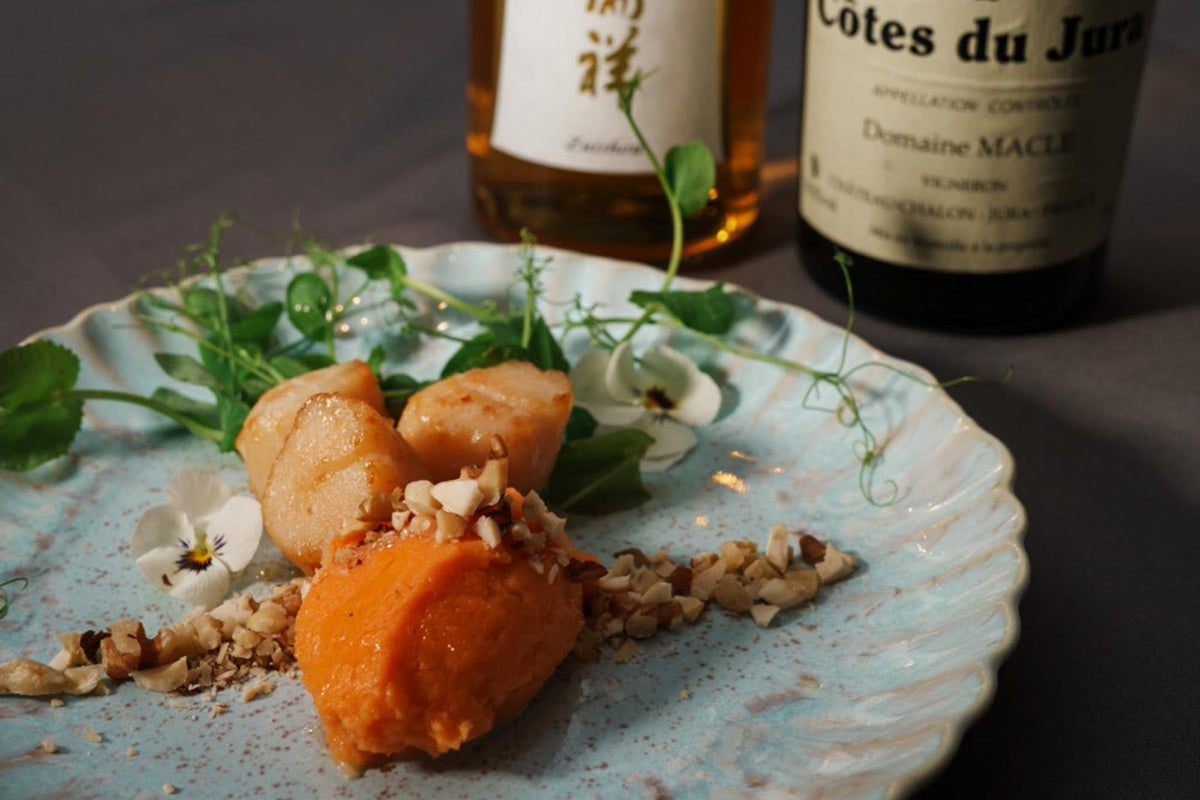
If you have studied wine at any level, you have probably met this type of pairing framework already.
Sweetness and umami in food make a drink taste harder — more drying, more bitter, more acidic, less sweet and less fruity. Acidity and salt, on the other hand, make it taste softer. Chilli heat sits apart from all four, because it is a touch sensation rather than a taste: it makes the alcohol more noticeable and sharpens the bitterness alongside it.
In a class, the reactions are mostly consistent. What varies is how strongly people feel them, and that turns out to depend a great deal on what they grew up eating. One student who had lived in Thailand for years had far more tolerance for chilli heat, and found combinations comfortable that the rest of the room could not handle.
So the principles hold for any drink. What changes is the drink you point them at. Which raises a question: why does sake succeed in exactly the places where wine has the most trouble?
Sources: taste interaction principles, the work of Tim Hanni MW.

Three things wine has
Ask a sommelier which foods are hardest to put a wine next to and you will hear a short list. Asparagus. Eggs. Seafood. Mushrooms.
The first three share a shape: the problem is something in the wine rather than something missing from it. Mushrooms are a different case, and we will come back to them.
For instance, asparagus contains asparagusic acid and methionine, a sulfur-bearing amino acid. Both break down into molecules like methyl mercaptan — the same family that shows up in wine as a reduction fault. You are not introducing sulfur to a clean drink. You are adding it to a drink that already carries some, and the two stack. Eggs do the same thing.
Another example is the fishy aftertaste that follows seafood. Contrary to the long-standing assumption, the cause is not tannin. A study tested thirty-eight red wines and twenty-six whites alongside dried scallop, and what tracked with the fishy ratings was iron in the wine. Seafood is rich in unsaturated fats; iron oxidises them in the mouth, and oxidation produces aldehydes. Those aldehydes are what you are smelling. The fish was never the problem, and neither was the wine — but the wine brought the catalyst and the fish brought the fuel. The proof is neat: lock up the iron and the aftertaste stops happening.
Sulfites do the same thing by another route. A second study paired white wine and sake with dried squid, then added one of those unsaturated fats to each. Bitterness and aldehydes rose sharply in the wine and did not move in the sake — and of everything that separates the two drinks, the sulfite was what did it.
Two mechanisms, the same fats, the same aldehydes. Neither one present in a glass of sake.
Sources: Tamura et al., Journal of Agricultural and Food Chemistry, 2009; Fujita et al., ibid., 2010.
What sake does not have
What sake does not have
The pattern behind all of this is that sake carries very little of whatever it is that reacts badly.
Iron, in the case of seafood — and not by accident. The water a brewery uses must be almost free of it, because a trace is enough to spoil the colour and the aroma. Breweries have been choosing their water on that basis for centuries, for reasons that had nothing to do with fish. No added sulfites either. And very little sulfur of any kind, so the asparagus has nothing to meet halfway.
While we are at it: low acidity, and almost no tannin. Unrelated to the fishy aftertaste, but tannin does plenty of other damage. Bitterness in food adds to bitterness in the drink, and tannin is where that bitterness lives.
That is the whole of it. Sake is said to go with almost anything, and this is why — not because it is especially accommodating, but because there is so little in it to go wrong.

What sake does have
All of that is an argument from absence. The argument from presence is the better one — and it is where the mushrooms come back.
Sake has umami of its own, and a great deal of it. Champagne gets talked about as the umami wine, and next to other wines it is. When someone measured sake, wine, champagne and beer side by side, sake came out highest of all of them — not narrowly.
Which matters because of where we started. Umami in food makes a drink taste harder. That is the whole of the mushroom problem, and the soft cheese problem: high umami, not much salt to rescue it.
But umami compounds do not add up. They multiply each other. So when the drink arrives with plenty of its own, something different happens: a separate study measured what alcohol does to the umami in a dish, and sake raised it every single time, more than any other drink tested. The largest jumps were with seafood.
The food stops hardening the drink and starts building it instead. The very thing that makes those dishes difficult for wine is the thing sake is equipped for.
It does not survive the umami on the plate. It gets bigger because of it.
Sources: Schmidt et al., Food Chemistry, 2021; umami index study by JFOODO and AISSY, 2020.
📍 In your glass
📍 In your glass
Three markers for a sake with real umami in it. Rice that was not polished far. Kimoto or yamahai. Anything that has been aged. Any one of the three will do.
Buy a bottle, then cook the dish this piece has been circling: mushrooms, fried in butter, salted very lightly. Less salt than you want. Salt is what usually rescues a pairing, and the point here is to take the rescue away.
Open a white wine too.
Taste the mushrooms. Then the wine. Then the mushrooms again.
Now do the same with the sake.
The question is not which you prefer — it is which mushroom tastes better the second time.

The next step
If you have read this far and found it interesting, then a course is probably the right next thing — because everything above sits on top of a foundation, and Level 1 and Level 2 are where that foundation gets built properly, step by step.
WSET Sake Course
Level 1 Award in Sake is a single day in Amsterdam: six hours, eight sakes chosen to give you the skeleton of the whole category, and an internationally recognised certificate at the end.
Level 2 goes considerably further into how sake is made and how the styles differ.
More in this series

Temperature and Glassware
A wine list sorts by colour before anything else. Sake has every colour on that list, and one more — and each one is telling you something about what was done after fermentation.

Sake Styles, the Wine Way
A wine list sorts by colour before anything else. Sake has every colour on that list, and one more — and each one is telling you something about what was done after fermentation.

Reading a sake label
Most of a label is not for you. Five words predict how a bottle will taste — and one character, a jar drawn three thousand years ago, unlocks the rest.

How sake is made
Rice has no sugar and no acid. Both are made by living things — and four decisions a brewer makes along the way separate one bottle from the next.